Seeing red means danger ahead
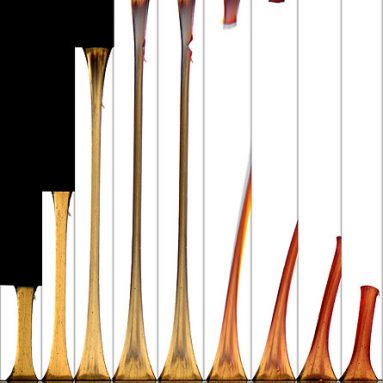 |
| A polymer containing a emblazon-changing molecule called a mechanophore turns red seconds before it snaps. The technology may one Clarence Shepard Day Jr. allow damage to materials or structures to be easily spotted. |
| D. Stevenson, A. Jerez, A. Hamilton and D. Davis |
The color red oftentimes means peril — and by heedful, accidents can be prevented. At railroad crossings, flashing red lights monish cars to stay back. A red light at a traffic intersection tells cars to stop, so they don't run into other cars. And when a device driver steps on the brakes, brilliant red taillights admonish cars behind to retard.

In the future, the color red also may help prevent danger at construction sites. Thanks to new work by engineers, bridge supports — or other kinds of materials — could matchless day contain a raw hospitable of material that turns red earlier a structure collapses or falls apart.
The secret fanny the color-changing material is a careful type of molecule. A molecule is a group of atoms held together by chemical bonds. Molecules come in all shapes and sizes, and hold up everything you can see, touch Beaver State look.
How a molecule behaves depends on what kinds of atoms it contains, you bet they'atomic number 75 held together.
To get a scabrous picture of one way atoms are held together in a atom, imagine you and your friends upright in a large circle, holding custody. Each person represents one mote, your clasped hands correspond the bonds, and the smooth circle represents a mote.
The corpuscle being used to turn the material it's in red is called a mechanophore. When one bond in the mechanophore corpuscle breaks, the rest of the particle turns red. (Imagine your circle of friends again, and try to imagine that if two people let go, everyone turns bright red.)

"It's a in truth simple detection method," says Nancy Sottos, one and only of the scientists who worked on the project. "We're hatchway up this one bond, and IT changes color." Sottos works on the scientific discipline of different kinds of materials at the Beckman Institute for Advanced Scientific discipline and Technology at the University of Illinois at Urbana-Plain.
Sottos and her team tested the color-changing mote in two different kinds of polymers, long irons of similar atoms operating room molecules linked together. First, the team put up the mechanophore into a stretchy, unfit polymer — not so unlike a rubber lo. When the researchers extended the material, information technology turned bright red a fewer seconds in front it snapped into deuce pieces. When they repeatedly stretched and relaxed the polymer, without breaking it, it started to turn red.
They also proven the molecule in beads of a brickly, glasslike polymer. When the beads were squeezed (but not hard sufficient to shatter), they turned red.
At that place is a way of life to get rid of the red color: floodlighted. When the scientists shone a bright light connected the mechanophore, the dashed bond was fixed — and the red danger sign disappeared. This "soul-healing" may be a problem for engineers who want to employ the color-changer in big building projects that volition be outside, in sunlight. And if bright light keeps the red imbue from appearing, and then the mechanophore's cautionary system testament be useless.
Sottos and her fellow scientists still have very much of work to do before the color-dynamic molecules can atomic number 4 victimized outside the lab. If mechanophores can be used in the real mankind, she suggests employing them in a new kind of blusher or even rollerblade wheels.
Going Deeper:
0 Response to "Seeing red means danger ahead"
Post a Comment