Hdf 110 Explain the Current Differences Between the Net Worth of Black and White Families.
Ethnicity, Language and Immigration Thematic Serial
Canada's Black population: Teaching, labour and resilience

Release date: February 25, 2020
Skip to text
Text begins
Introduction
This booklet is part of a series of documents released in conjunction with the United nations' International Decade for People of African Descent (2015 to 2024) and Black History Month. It aims to provide insight into some of the key socioeconomic characteristics of Canada'southward Black communities.
The kickoff booklet in this series titled "Multifariousness of the Black population in Canada: An overview", was released in Feb 2019 and highlighted both the demographic characteristics and diverseness of this population. Among others, the booklet demonstrated that the Black population which represents shut to 1.2 million people in 2016, is not only diverse, but too young and growing in size.
To obtain a more than comprehensive portrait of this population, this second booklet presents indicators related to teaching, employment, income, family structures and perceptions using data from the census and the Full general Social Survey (GSS).
This booklet first looks at the education characteristics of the Blackness population, which are associated with several other aspects of their socioeconomic situation. An analysis of the highest level of educational attainment was disaggregated past sex and immigrant status, followed by data on the educational expectations and aspirations of young Black individuals.
The Blackness population'south labour market outcomes are the focus of the second function of this booklet. In addition to employment, unemployment and income indicators, there are also data presented on work experiences, including their perceived experience of bigotry and their level of satisfaction.
Information on coping with life'southward difficulties and perceptions of the future are presented in the 3rd part of this booklet.
Some socioeconomic indicators are and so presented for selected census metropolitan areas (CMA), which testify that, far from being homogeneous, the state of affairs of the Black population varies greatly from one part of the country to some other.
Population of interest
There are many unlike ways to define and measure the population of interest. It is a population that comprises a diverse community of people in terms of history, indigenous and cultural origins, identify of birth, religion, and languages.
For this portrait, the population of interest refers to people who self-identified as "Black" in the population group question in the Census of Population. Since the 1996 Census, "Black" is one of the population groups listed on the census questionnaire. Respondents can select i or more of the listed population groups, or specify another group. With the exception of respondents who identified as belonging to both "Black" and "White" population groups, multiple responses are excluded from this analysis.
In the Full general Social Survey, the population of interest besides refers to those who selected "Blackness" to a similar population group question.
Given the focus and scope of this booklet, the population who did not cocky-place as "Black" was regrouped into a single reference category labelled equally "the rest of the population". This arroyo, used to put in perspective the specificities of the Black population through comparisons, does not presume that the "remainder of the population" is a homogeneous entity.

Source: Statistics Canada, 2016 Census of Population 2A-L questionnaire.
Description for questionnaire
The prototype shows question xix on population groups from the 2016 Census of Population 2A-Fifty questionnaire. Respondents were asked 'Is this person:' and were instructed to marking ane or more of the eleven mark-in categories, or to specify some other grouping in the write-in space, if applicable. The list of marker-in categories are the following:
- White
- South Asian (eastward.g., E Indian, Pakistani, Sri Lankan, etc.)
- Chinese
- Black
- Filipino
- Latin American
- Arab
- Southeast Asian (e.g., Vietnamese, Cambodian, Laotian, Thai, etc.)
- Westward Asian (e.g., Iranian, Afghan, etc.)
- Korean
- Japanese
- Other - specify
In 2016, close to 7 in 10 Black adults had a postsecondary diploma
The highest level of educational attainment among the Black population varied by sex and immigrant condition.
| Women | Men | |
|---|---|---|
| percent | ||
| Total Black population | ||
| Total — Highest certificate, diploma or degree | 100.0 | 100.0 |
| No certificate, diploma or degree | x.3 | 10.nine |
| Secondary (high) school diploma or equivalency document | 19.0 | 26.5 |
| Apprenticeship or trades certificate or diploma | 9.viii | 11.1 |
| College, CEGEP or other non-university certificate or diploma | 28.6 | nineteen.7 |
| University certificate or diploma below bachelor level | 4.8 | 4.1 |
| University certificate, diploma or degree at bachelor level or above | 27.v | 27.seven |
| Immigrants | ||
| Full — Highest document, diploma or degree | 100.0 | 100.0 |
| No certificate, diploma or degree | 11.7 | 10.eight |
| Secondary (high) school diploma or equivalency document | eighteen.4 | 24.seven |
| Apprenticeship or trades certificate or diploma | 11.1 | 11.iv |
| College, CEGEP or other non-university certificate or diploma | 28.v | 18.six |
| Academy certificate or diploma below available level | 5.0 | four.6 |
| University certificate, diploma or caste at bachelor level or to a higher place | 25.4 | 29.viii |
| Non-immigrants | ||
| Total — Highest certificate, diploma or caste | 100.0 | 100.0 |
| No certificate, diploma or degree | 6.one | 11.1 |
| Secondary (loftier) school diploma or equivalency certificate | 21.0 | 32.9 |
| Apprenticeship or trades certificate or diploma | vi.4 | 10.7 |
| College, CEGEP or other not-academy certificate or diploma | 31.ane | 24.1 |
| University certificate or diploma below bachelor level | iv.0 | 2.8 |
| University certificate, diploma or degree at bachelor level or above | 31.4 | xviii.4 |
| Source: Statistics Canada, Census of Population, 2016. | ||
The differences are notable among those with a bachelor's degree or higher. Amidst the non-immigrant population, 18% of Black men had a bachelor's degree or higher in 2016, compared to 31% of Black women (a similar situation in the rest of the population).
The immigrant population is more often than not more than likely to have a bachelor's degree or higher than the non-immigrant population. It was the opposite for Black women. In 2016, 25% of Black immigrant women had a available's caste or higher, compared to 31% of Black not-immigrant women.
This can be partly explained past immigrant access categories. It is most notable amongst Black immigrants from Africa where a higher proportion of men than women were chosen, in office for their skills and qualifications, such as educational attainment.
| Blackness women | Women in the residual of the population | Black men | Men in the residual of the population | |
|---|---|---|---|---|
| per centum | ||||
| Total population | 27.5 | 32.vii | 27.7 | 26.7 |
| Immigrants | 25.four | 42.8 | 29.eight | 42.3 |
| Not-immigrants | 31.four | 28.vi | 18.4 | 21.one |
| Source: Statistics Canada, Demography of Population, 2016. | ||||
The proportion of Black women with a postsecondary educational activity has increased over time
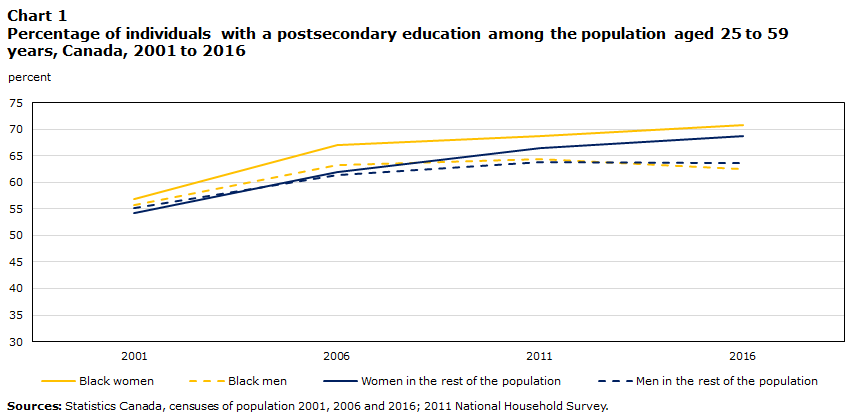
Data table for Chart 1
| Black women | Black men | Women in the rest of the population | Men in the rest of the population | |
|---|---|---|---|---|
| percentage | ||||
| 2001 | 56.9 | 55.viii | 54.3 | 55.1 |
| 2006 | 67.1 | 63.3 | 61.9 | 61.four |
| 2011 | 68.8 | 64.5 | 66.4 | 63.9 |
| 2016 | 70.7 | 62.half-dozen | 68.six | 63.vi |
| Sources: Statistics Canada, censuses of population 2001, 2006 and 2016; 2011 National Household Survey. | ||||
In general, the proportion of Canadians with a postsecondary didactics has increased since 2001. This increase was more pronounced amidst women than amongst men, for both the Blackness population and the residual of the population.
Since 2011, however, there has been a decline in the proportion of Black men with a postsecondary didactics, while the proportion remained stable for men in the remainder of the population.
Near Black youth would similar to obtain a university degree, but proportionally, they are less likely to think that they will obtain one
In 2016, although 94% of Black youth anile 15 to 25 said that they would like to go a bachelor's degree or higher, lx% idea that they could.

Information tabular array for Nautical chart two
| Black population | Rest of the population | |||||
|---|---|---|---|---|---|---|
| Pct | 95% confidence interval | Per centum | 95% conviction interval | |||
| lower | upper | lower | upper | |||
| Would similar to obtain a university degree | 93.9 Note* | 85.6 | 102.3 | 82.4 | 79.ix | 84.eight |
| Think they will obtain a university caste | 59.9 | 43.5 | 76.2 | 78.8 | 76.ane | 81.4 |
| ||||||
Some authors suggest that students' perceptions nigh their educational attainment potential may be influenced, among other things, by certain teachers and other professionals in the school system (James and Turner 2017; Fitzpatrick et al. 2015; Burgess and Greaves 2013; James 2000).
Black men saw both their employment rates fall and their unemployment rates ascension over fourth dimension
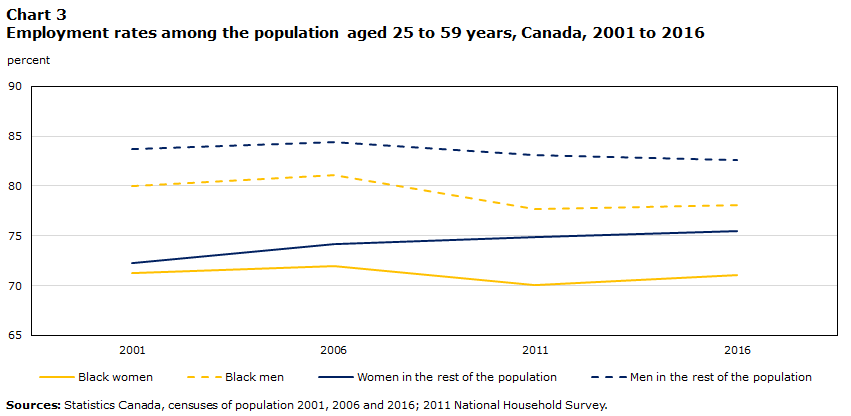
Information table for Chart three
| Black women | Black men | Women in the balance of the population | Men in the remainder of the population | |
|---|---|---|---|---|
| percentage | ||||
| 2001 | 71.3 | lxxx.0 | 72.three | 83.7 |
| 2006 | 72.0 | 81.1 | 74.ii | 84.iv |
| 2011 | 70.0 | 77.7 | 74.ix | 83.1 |
| 2016 | 71.0 | 78.one | 75.5 | 82.half dozen |
| Sources: Statistics Canada, censuses of population 2001, 2006 and 2016; 2011 National Household Survey. | ||||
The employment rate of Black people anile 25 to 59 is lower than in the rest of the population. In 2016, the employment rate was 78.i% for Blackness men and 71.0% for Black women, compared with 82.vi% and 75.5%, respectively, for their counterpart in the rest of the population.
Betwixt 2001 and 2011, the gap in the employment rate betwixt the Blackness population and the rest of population increased, for both women and men. However, this gap decreased slightly between 2011 and 2016.

Data table for Chart 4
| Black women | Black men | Women in the rest of the population | Men in the residuum of the population | |
|---|---|---|---|---|
| percent | ||||
| 2001 | 10.2 | 9.1 | 6.0 | six.iii |
| 2006 | 9.5 | 8.0 | 5.4 | five.2 |
| 2011 | x.9 | x.4 | 5.ix | 6.2 |
| 2016 | x.ii | 10.2 | 5.8 | 6.7 |
| Sources: Statistics Canada, censuses of population 2001, 2006 and 2016; 2011 National Household Survey. | ||||
During this catamenia, the unemployment rates among the Black population were consistently higher than in the rest of the population.
This was the case even at higher levels of pedagogy. For example, amongst those with a postsecondary education in 2016, the unemployment rate for the Blackness population was 9.2%, compared to 5.3% for those in the balance of the population.
These gaps betwixt the groups in employment and unemployment rates persist even after decision-making for the effects of various socioeconomic factors, suggesting that other factors, not measured in the demography, may be at work (Houle 2020).
Canadian studies (e.g., Oreopoulous 2011 and Eid 2012) used fictitious resumes and found that, among other things, "racialized" candidates were significantly less likely to be interviewed than other candidates with the same levels of qualification and equivalent experience.
Despite hardships in the workforce, Black individuals were generally satisfied with their jobs
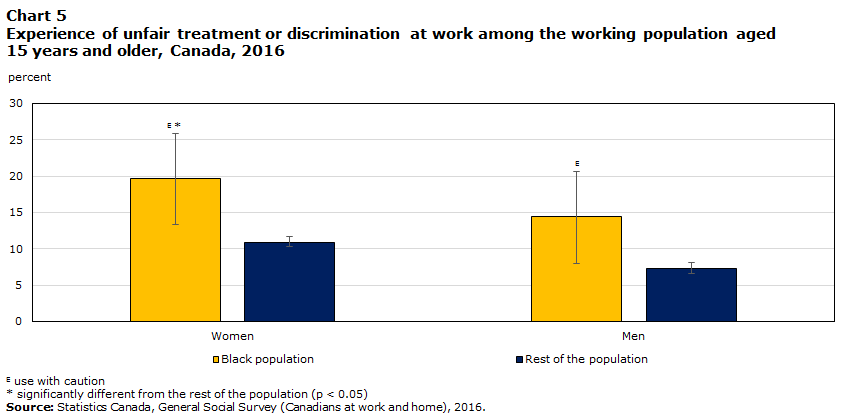
Data table for Nautical chart 5
| Women | Men | |||||
|---|---|---|---|---|---|---|
| Percent | 95% confidence interval | Percent | 95% confidence interval | |||
| lower | upper | lower | upper | |||
| Black population | 19.6 NoteE: Use with circumspection Note* | 13.four | 25.9 | 14.iv NoteE: Use with circumspection | 8.ane | 20.8 |
| Residue of the population | 10.9 | ten.ane | 11.7 | 7.3 | 6.half-dozen | 8.0 |
E employ with caution
| ||||||
According to information from the 2016 GSS, Black employees anile xv or over, were more likely than their counterparts in the rest of the population to written report having experienced unfair handling or discrimination at work in the 12 months prior to the survey.
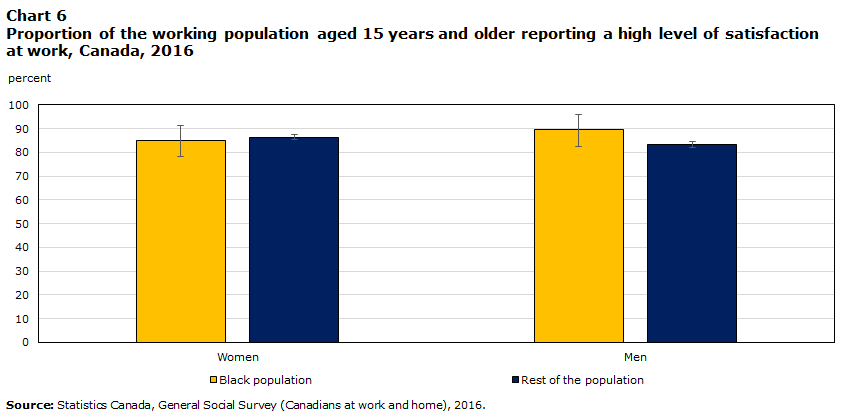
Data table for Chart 6
| Women | Men | |||||
|---|---|---|---|---|---|---|
| Per centum | 95% confidence interval | Percent | 95% conviction interval | |||
| lower | upper | lower | upper | |||
| Black population | 85.0 | 78.half dozen | 91.3 | 89.5 | 82.seven | 96.3 |
| Rest of the population | 86.iii | 85.2 | 87.three | 83.4 | 82.3 | 84.6 |
| Source: Statistics Canada, General Social Survey (Canadians at work and abode), 2016. | ||||||
At the same fourth dimension, the majority of the Black population reported a high level of job satisfaction, with 85% of Blackness women and 90% of Black men.
Additionally, 79% of employed Black individuals felt a strong sense of belonging to the organization for which they worked, similar to results in the remainder of the population (82%).
Friends are oft a source of support in the workplace for the Black population. About iii in x Black employees reported having many skillful friends at work, and around ii in x reported having having ane ot two expert friends at work. These results were similar in the balance of the population.
Many inequalities that are observed in society may persist even when the structural conditions that created them have changed (United nations Department of Economic and Social Affairs 2016).
The gap in median almanac wages between Black men and their counterparts in the rest of the population has persisted over time

Data table for Nautical chart seven
| Black women | Blackness men | Women in the rest of the population | Men in the residue of the population | |
|---|---|---|---|---|
| dollars | ||||
| 2000 | 32,552 | 40,214 | 33,854 | 52,083 |
| 2005 | 33,188 | xl,116 | 35,094 | 52,557 |
| 2010 | 36,358 | 41,911 | 38,961 | 54,501 |
| 2015 | 35,663 | 41,146 | 39,654 | 55,801 |
| ||||
While median almanac wages increased in the full general population from 2000 to 2015, it remained relatively stable for Black men, at approximately $twoscore,000.
In 2000 and 2005, Black women earned median annual wages similar to those of women in the rest of the population. Since so, however, the gap between the two groups of women has increased.
Amidst immigrant women, the wage gaps between Black women and women in the residue of the population was very low ($1,300 difference at well-nigh, favouring Black women). Conversely, among those born in Canada, the almanac wages of Black women were approximately $iii,500 to $seven,000 lower than that of women in the balance of the population.
About 1 in 5 Black adults alive in a low-income situation

Data table for Nautical chart viii
| Black population | Residuum of the population | |
|---|---|---|
| percent | ||
| 2015 | twenty.7 | 12.0 |
| Source: Statistics Canada, Census of Population 2016. | ||
In 2016, 21% of the Black population anile 25 to 59 lived in a depression-income situation, compared with 12% of their counterparts in the balance of the population.
In 2016, 27% of Black children were living in a low-income situation, compared to 14% of children in the residual of the population.
In 2016, one-3rd of Black adults lived with children at abode
| Black population | Rest of the population | |
|---|---|---|
| percent | ||
| Total | 100.0 | 100.0 |
| In a couple without children | 8.seven | 25.9 |
| In a couple with children | 33.9 | 36.0 |
| In a lone-parent family | 19.3 | 7.9 |
| Persons in multigenerational households | 8.v | 5.7 |
| Living with others (relatives or non-relatives) | 17.3 | 10.7 |
| Living alone | 12.3 | 13.9 |
| Source: Statistics Canada, Census of Population, 2016. | ||
In Canada, close to ii in 10 Black individuals were in lone-parent families.
Regarding the household living arrangements of individuals, living in a couple with children (34%) was the well-nigh common state of affairs for the Blackness population, a event similar to what is observed in the rest of the population. However, the proportion of persons in a lone-parent family was at least two times higher in the Black population than in the residual of the population (nineteen% and viii%, respectively). Among the Black population, nearly 70% of these lonely-parents were women.
Black immigrant women take a higher rate of lone parenthood than other immigrant women. In 2016, most 30% of Black immigrant women anile 25 to 59 were lone-parents. This was 20 percentage points higher among women in the balance of the immigrant population.
In 2016, Black alone-parents were more likely to exist living in a depression-income state of affairs (34%) compared with lone-parents in the residual of the population (26%).
Many parental characteristics—such as immigrant status, single parenthood, unemployment, low education or low wages—may be associated with children and youth living in poverty (Lichter and Eggebeen 1994; Thomas 2011).
Black individuals demonstrated potent levels of resilience, even when faced with hard times
In 2016, 44% of Blackness individuals said they were "always" able to bounce dorsum rapidly later on hard times, compared to 33% amidst the rest of the population.
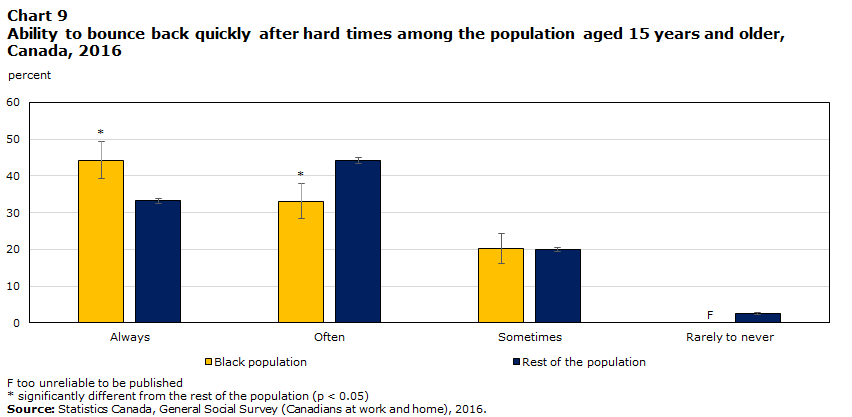
Data table for Nautical chart nine
| Black population | Residual of the population | |||||
|---|---|---|---|---|---|---|
| Percent | 95% confidence interval | Pct | 95% conviction interval | |||
| lower | upper | lower | upper | |||
| Always | 44.ii Notation* | 39.2 | 49.ii | 33.3 | 32.half dozen | 33.9 |
| Often | 33.i Note* | 28.4 | 37.viii | 44.2 | 43.5 | 44.9 |
| Sometimes | twenty.4 | sixteen.3 | 24.4 | 20.ane | xix.5 | 20.7 |
| Rarely to never | NotationF: too unreliable to be published | NotationF: too unreliable to be published | AnnotationF: too unreliable to exist published | 2.five | 2.three | two.7 |
F too unreliable to be published
| ||||||
Resilience can be defined as the "power to course a successful adaptation in the face of obstacles and adversity" (Seiler, Shamonda and Thompson 2011).
A key to resilience is how individuals make sense of negative experiences (Seiler, Shamonda and Thompson 2011). After difficult experiences, 65% of the Black population felt that they "always" learned something from those experiences compared with 48% in the remainder of the population.
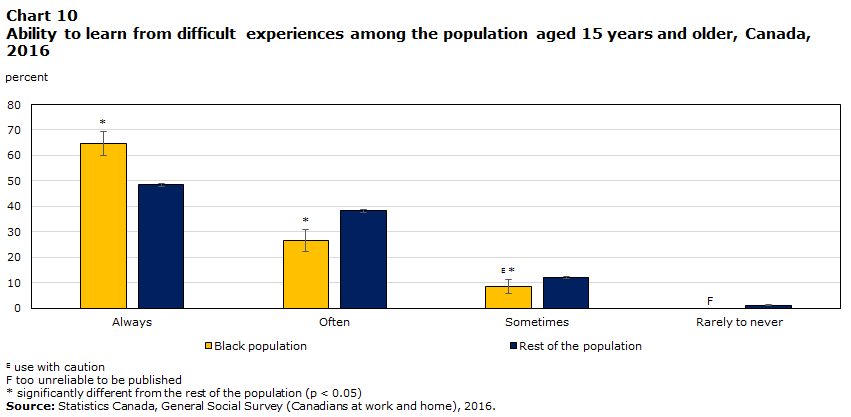
Data table for Chart x
| Black population | Residuum of the population | |||||
|---|---|---|---|---|---|---|
| Percent | 95% conviction interval | Percent | 95% confidence interval | |||
| lower | upper | lower | upper | |||
| Ever | 64.7 Note* | 59.ix | 69.five | 48.4 | 47.6 | 49.ane |
| Often | 26.5 Note* | 22.1 | thirty.ix | 38.3 | 37.6 | 39.0 |
| Sometimes | 8.5 NoteE: Use with caution Notation* | 5.vii | 11.3 | 12.ii | 11.vii | 12.6 |
| Rarely to never | NotationF: likewise unreliable to be published | AnnotationF: too unreliable to exist published | NoteF: likewise unreliable to be published | 1.2 | 1.1 | 1.4 |
| East utilize with circumspection F too unreliable to be published
| ||||||
Compared with the residual of the population, Black individuals were more than probable to written report that, after hard experiences, they were "always" able to continue going about their life every bit they normally would (41% vs 32%).
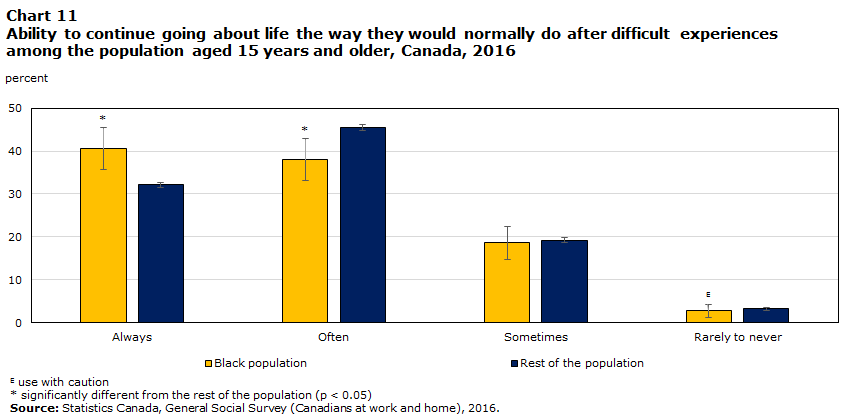
Information table for Chart 11
| Black population | Rest of the population | |||||
|---|---|---|---|---|---|---|
| Percent | 95% confidence interval | Percent | 95% confidence interval | |||
| lower | upper | lower | upper | |||
| Ever | xl.vii Annotation* | 35.7 | 45.half-dozen | 32.1 | 31.4 | 32.viii |
| Often | 38.i Note* | 33.2 | 42.9 | 45.5 | 44.viii | 46.iii |
| Sometimes | 18.6 | 14.7 | 22.5 | xix.2 | 18.6 | 19.7 |
| Rarely to never | ii.7 AnnotationEastward: Use with caution | ane.ane | iv.3 | three.two | two.9 | 3.4 |
East utilise with caution
| ||||||
The perceived future looks bright for most of the Black population

Information tabular array for Chart 12
| Blackness population | Rest of the population | |||||
|---|---|---|---|---|---|---|
| Percentage | 95% confidence interval | Per centum | 95% confidence interval | |||
| lower | upper | lower | upper | |||
| Standard of living of household | 63.1 Note* | 58.0 | 68.i | 55.eight | 55.0 | 56.5 |
| Educational opportunities | 81.8 Notation* | 77.nine | 85.7 | 76.0 | 75.four | 76.6 |
| Employment opportunities | 75.ane Notation* | seventy.7 | 79.5 | 54.viii | 54.1 | 55.5 |
| Opportunities to acquire avails | 58.5 Note* | 53.five | 63.5 | 44.5 | 43.8 | 45.3 |
| ||||||
In 2016, the bulk of the Blackness population ranked their standard of living, educational and employment opportunities, and opportunities to acquire assets as ameliorate than those of their parents.
Well-nigh notably, compared with the residue of the population (55%), more Black individuals (75%) felt that their employment opportunities were better than those of their parents.
Too, among the Black population, 76% of the immigrants and 85% of the non-immigrants felt that their life opportunities would improve in the adjacent five years. These proportions were significantly college than for the remainder of the population, where 57% of the immigrants and 46% of the non-immigrants felt that their life opportunities would improve.
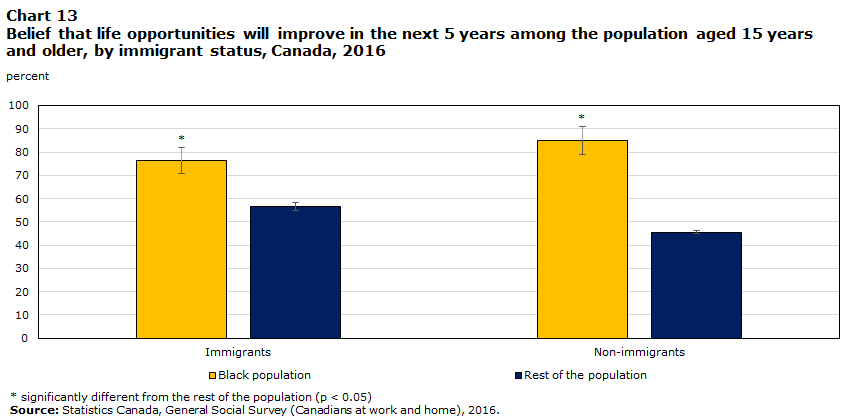
Data table for Nautical chart xiii
| Black population | Residuum of the population | |||||
|---|---|---|---|---|---|---|
| Percentage | 95% confidence interval | Pct | 95% confidence interval | |||
| lower | upper | lower | upper | |||
| Immigrants | 76.four Notation* | 70.nine | 81.viii | 56.5 | 54.7 | 58.3 |
| Non-immigrants | 85.0 Note* | 79.1 | xc.9 | 45.6 | 44.9 | 46.4 |
| ||||||
Geographical highlights
Below is a quick overview of some education, labour and income characteristics for the population aged 25 to 59, as well as the prevalence of depression-income for children under the age of 15, for eight selected demography metropolitan areas (CMAs) across Canada. In 2016, about eight in x Black people lived in these CMAs.

Halifax
The unemployment rate for Black men was about two and a half times college than the rate for men in the remainder of the population of this region.

Montréal
Merely under ane in 5 Black children lived in a low-income household, lowest proportion amongst these eight CMAs.

Ottawa-Gatineau
Four in 10 Blackness men held at to the lowest degree a available's degree, like to their male person counterparts in this region, notwithstanding in that location was a wide gap in terms of median almanac wages.

Toronto
Ii in x Black men held a bachelor's caste or higher, compared to almost 4 in 10 of men in the rest of the population of this region.

Winnipeg
Black men were more probable to take at least a available's degree than other men of this region.

Calgary
A wide gap in terms of median annual wages between both Black men and women and their counterparts living in this region.

Edmonton
A wide gap in terms of median annual wages between Black men and other men living in this region.

Vancouver
In this region, Blackness women and other women had similar median annual wages.
Source: Statistics Canada, Demography of Population, 2016.
Halifax—6,385 Black individuals (aged 25 to 59)
Education
(Available level or above)
| Blackness Population | Balance of the Population | |
|---|---|---|
| pct | ||
| Women | 26.9 | 40.8 |
| Men | 26.one | 32.three |
Both men and women in the Black population were less likely than their counterparts in the rest of the population to concur a bachelor'south caste or higher, only the gap was more pronounced for women (14 pct points).
Labour
(Unemployment rate)
| Black Population | Rest of the Population | |
|---|---|---|
| percent | ||
| Women | 11.2 | 4.9 |
| Men | 14.1 | v.7 |
The unemployment rate for Black men was 2 and a half times higher than that for men in the rest of the population.
Income
(Median annual wages)
| Black Population | Rest of the Population | |
|---|---|---|
| dollars | ||
| Women | 31,727 | 39,563 |
| Men | 35,747 | 55,340 |
In that location was a gap of $20,000 betwixt median annual wages of Black men and that for the other men of this region. For women, the gap was not equally large ($eight,000).
Family
(Children in depression-income)
| Black Children | Children in the rest of the population | |
|---|---|---|
| percentage | ||
| Children | 38.5 | 15.9 |
The percentage of Black children living in a low-income situation in Halifax was 38.five%—more than than double the per centum for the rest of the population.
Montréal—129,185 Black individuals (aged 25 to 59)
Education
(Bachelor level or above)
| Black Population | Residuum of the Population | |
|---|---|---|
| percentage | ||
| Women | 26.5 | 36.2 |
| Men | 29.6 | 30.7 |
While Black men were almost as likely as men in the rest of the population to agree at least a bachelor'southward caste, Black women were less likely to do and then than women in the rest of the population by 10 percentage points.
Labour
(Unemployment rate)
| Blackness Population | Rest of the Population | |
|---|---|---|
| pct | ||
| Women | 10.seven | 5.6 |
| Men | eleven.4 | half dozen.2 |
Unemployment rates for Black women and men were nearly double those of their counterparts in the rest of the population.
Income
(Median annual wages)
| Black Population | Rest of the Population | |
|---|---|---|
| dollars | ||
| Women | 30,710 | 39,154 |
| Men | 34,243 | 50,276 |
While median annual wages among Black women and men were similar, large gaps existed between the Blackness population and the rest of the population, especially for men.
Family
(Children in depression-income)
| Black Children | Children in the rest of the population | |
|---|---|---|
| per centum | ||
| Children | 18.2 | 11.1 |
A larger proportion (18.2%) of Black children in Montréal were living in a depression-income situation compared with children in the residue of the population (11.one%).
Ottawa–Gatineau—34,465 Black individuals (aged 25 to 59)
Education
(Available level or to a higher place)
| Black Population | Rest of the Population | |
|---|---|---|
| percent | ||
| Women | 35.i | 43.eight |
| Men | 40.3 | 38.3 |
Black men were more probable than their counterparts in the residue of the population to have a bachelor's degree or higher, although it was the opposite for Blackness women.
Labour
(Unemployment rate)
| Blackness Population | Balance of the Population | |
|---|---|---|
| percent | ||
| Women | 9.7 | iv.6 |
| Men | 11.1 | 5.0 |
Unemployment rates for Black women and men were more than 2 times higher than those for their counterparts in the rest of the population.
Income
(Median almanac wages)
| Black Population | Residuum of the Population | |
|---|---|---|
| dollars | ||
| Women | 36,879 | 51,793 |
| Men | 40,762 | 63,384 |
Median annual wages were largely lower for Blackness women and men (by $23,000) than for their counterparts in the residual of the population, with gaps of $15,000 amongst women and $23,000 among men.
Family
(Children in low-income)
| Black Children | Children in the residue of the population | |
|---|---|---|
| pct | ||
| Children | 29.2 | eleven.7 |
Close to thirty% of Black children in this region were living in a depression-income situation — 17.v pct points college than for children in the rest of the population.
Toronto—207,480 Blackness individuals (anile 25 to 59)
Education
(Bachelor level or above)
| Black Population | Rest of the Population | |
|---|---|---|
| percent | ||
| Women | 25.iii | 45.2 |
| Men | 21.9 | 41.7 |
Blackness men and women in this region were almost half as probable to hold a bachelor's degree or college compared to their counterparts in the residue of the population.
Labour
(Unemployment rate)
| Black Population | Remainder of the Population | |
|---|---|---|
| percent | ||
| Women | 9.9 | 6.iv |
| Men | 8.9 | five.iii |
The unemployment rate for Black women and men was about ane and a half times higher than the rate for women and men in the rest of the population.
Income
(Median annual wages)
| Blackness Population | Residue of the Population | |
|---|---|---|
| dollars | ||
| Women | 39,301 | 42,734 |
| Men | 43,695 | 56,648 |
The median annual wages of Black men and women were lower than those of their counterparts in the rest of the population, by close to $13,000 among men and by $three,400 among women.
Family
(Children in low-income)
| Blackness Children | Children in the rest of the population | |
|---|---|---|
| percent | ||
| Children | 34.ane | 18.4 |
Near 35% of Black children in Toronto were living in a low-income state of affairs, compared with close to xx% of children in the rest of the population.
Winnipeg—12,690 Black individuals (aged 25 to 59)
Education
(Bachelor level or above)
| Black Population | Remainder of the Population | |
|---|---|---|
| percent | ||
| Women | 33.4 | 36.2 |
| Men | 35.7 | 28.vii |
Black men were more than likely than men in the rest of the population to agree a bachelor'south caste or college, and Blackness women were but slightly less probable than other women to exercise so.
Labour
(Unemployment rate)
| Blackness Population | Balance of the Population | |
|---|---|---|
| per centum | ||
| Women | 7.7 | 4.half dozen |
| Men | 8.2 | 5.two |
Unemployment rates for Blackness women and men were more one and a half times higher than those for women and men in the rest of the population.
Income
(Median almanac wages)
| Black Population | Residue of the Population | |
|---|---|---|
| dollars | ||
| Women | 33,707 | 39,786 |
| Men | 39,581 | 52,336 |
Gaps existed in median annual wages between the Blackness population and the rest of the population, merely the gap betwixt Black men and men in the rest of the population was greater than the gap between Black women and women in the remainder of the population.
Family
(Children in low-income)
| Black Children | Children in the rest of the population | |
|---|---|---|
| percent | ||
| Children | 26.i | 16.i |
Compared with children in the balance of the population (16.i%), there were more than Blackness children living in a low-income situation (26.one%).
Calgary—27,195 Blackness individuals (aged 25 to 59)
Instruction
(Bachelor level or above)
| Black Population | Rest of the Population | |
|---|---|---|
| percentage | ||
| Women | 33.3 | 41.5 |
| Men | 37.0 | 37.2 |
Black men were just as likely every bit men in the rest of the population to hold at to the lowest degree a available's degree, only Black women were less likely than women in the remainder of the population to practise then.
Labour
(Unemployment charge per unit)
| Black Population | Rest of the Population | |
|---|---|---|
| percent | ||
| Women | 13.5 | 7.7 |
| Men | 13.i | viii.three |
Unemployment rates for Black women and men were more than one and a half times higher than those for women and men in the rest of the population.
Income
(Median annual wages)
| Black Population | Balance of the Population | |
|---|---|---|
| dollars | ||
| Women | 35,131 | 48,044 |
| Men | 48,553 | 69,882 |
The gap in median annual wages betwixt Black men and men in the rest of the population was over $20,000, and the gap betwixt Black women and women in the residue of the population was close to $13,000.
Family
(Children in low-income)
| Black Children | Children in the rest of the population | |
|---|---|---|
| percent | ||
| Children | 27.4 | 11.7 |
About 3 in ten Black children in Calgary were living in a depression-income situation, compared with 1 in 10 children in the rest of the population.
Edmonton—28,240 Black individuals (aged 25 to 59)
Instruction
(Bachelor level or higher up)
| Blackness Population | Rest of the Population | |
|---|---|---|
| percent | ||
| Women | 26.iv | 33.3 |
| Men | 27.four | 26.1 |
While Black men and men in the rest of the population were every bit likely to hold a bachelor'due south degree or higher, Black women were less likely than their counterparts in the residual of the population to accept like educational attainment.
Labour
(Unemployment charge per unit)
| Black Population | Rest of the Population | |
|---|---|---|
| percent | ||
| Women | 12.1 | six.3 |
| Men | xiii.5 | seven.9 |
Unemployment rates for Blackness women and men were almost two times higher than the rates for their counterparts in the residue of the population.
Income
(Median annual wages)
| Black Population | Rest of the Population | |
|---|---|---|
| dollars | ||
| Women | 36,310 | 46,198 |
| Men | 49,514 | 72,130 |
The gap in median almanac wages between Blackness women and women in the rest of the population was under $10,000, whereas the gap between Black men and men in the rest of the population was over $22,000.
Family
(Children in low-income)
| Black Children | Children in the balance of the Population | |
|---|---|---|
| percent | ||
| Children | 28.2 | 11.3 |
Three in ten Black children were living in a low-income situation, a rate three times college than that for children in the residual of the population.
Vancouver—14,360 Black individuals (aged 25 to 59)
Didactics
(Bachelor level or above)
| Black Population | Rest of the Population | |
|---|---|---|
| pct | ||
| Women | 29.6 | 41.0 |
| Men | 26.3 | 36.vii |
Both Black women and Black men were less likely to hold a available'southward degree or college compared to women and men in the residual of the population — a departure of about x per centum points.
Labour
(Unemployment charge per unit)
| Black Population | Rest of the Population | |
|---|---|---|
| percent | ||
| Women | eight.1 | 5.two |
| Men | vi.7 | 4.five |
The unemployment rate for the Blackness population (for both women and men) was approximately 1 and a half times higher than that for balance of the population.
Income
(Median annual wages)
| Black Population | Residual of the Population | |
|---|---|---|
| dollars | ||
| Women | 38,228 | 39,466 |
| Men | 42,961 | 55,188 |
Simply a modest gap existed between the median annual wages of Blackness women and women in the residuum of the population, just the gap between Black men and men in the rest of the population was over $12,000.
Family
(Children in low-income)
| Black Children | Children in the rest of the population | |
|---|---|---|
| per centum | ||
| Children | 31.9 | 18.0 |
There were close to two times more Black children living in a low-income situation (31.9%), compared with children in the residual of the population.
Source: Statistics Canada, Demography of Population, 2016.
Conclusion
This booklet presents some of the socioeconomic characteristics of the Blackness population in Canada, bringing to lite some of the challenges that this population faces, particularly in terms of employment and income.
Compared to the balance of the population, employment rates remain low and the prevalence of depression-income is more common amid the Blackness population. Despite these challenges, Black individuals accept high rates of chore satisfaction and loftier rates of resilience.
The analysis has demonstrated that the challenges facing the Black population may present themselves differently within specific groups, such as among immigrants or women and men.
At that place are notable differences between immigrants and non-immigrants in terms of postsecondary instruction. Immigrants are more likely to take a bachelor's degree or higher compared to non-immigrants. Withal, this human relationship was the reverse for Black women, with not-immigrants beingness more than likely to have a available's degree or higher than immigrants.
The Black population is not a homogenous ane. On the contrary, it is very diverse, whether in terms of ethnic or cultural origins, places of birth, languages and religions. Information technology is equally diverse in terms of experiences and socioeconomic characteristics, which are the subject of this booklet.
While this booklet aims to provide a brief overview of some of these experiences and characteristics, it cannot fully illustrate the diversity within, nor all the issues affecting the Blackness population in Canada. Studies such equally "Teaching and labour market integration of Black youth in Canada" (released February 25, 2020) and "Changes in the socioeconomic situation of Canada's Black population, 2001 to 2016" (to be released in spring 2020) provide a complement to, and a more in-depth analysis of the results seen in this booklet. The reader is invited to consult them, every bit each provides different perspectives on Black communities in Canada.
Recent Statistics Canada studies
"Changes in the socioeconomic state of affairs of Canada's Black population, 2001 to 2016," by René Houle
To be released in 2020 // Catalogue no. 89-657-X
"Education and labour market place integration of Black youth in Canada," by Martin Turcotte
Release date: February 25, 2020 // Catalogue no.75-006-X
- Black youth aged 9 to 13 in 2006 were as probable as other Canadian youth to accept graduated from high schoolhouse in 2016.
- Young Black men and women aged 13 to 17 in 2006 were less likely to have completed a postsecondary education in 2016 than their counterparts in the residuum of the population.
- Young Blackness men were most twice as likely than other immature men to be neither in employment, instruction, nor training in 2016.
"Intergenerational education mobility and labour market outcomes: Variation among the second generation of immigrants in Canada," past Wen-Hao Chen and Feng Hou
Release date: February 18, 2019 // Catalogue no. 11F0019M, no. 418
- Education progress across generations was moderate among Blackness men.
- Second-generation Black individuals showed moderate educational mobility and low educational attainment amidst men, and low earnings for both men and women.
"Law-reported hate crime in Canada, 2017," by Amelia Armstrong
Release appointment: April xx, 2019 // Catalogue no. 85-002-X
* An updated report from Juristat will exist available soon.
- Hate crimes targeting the Blackness population remained one of the most common types of detest crimes.
- Hate crimes against the Blackness population were more likely to be non-violent violations.
"Trigger-happy victimization and discrimination amid visible minority populations, Canada," by Laura Simpson
Release engagement: April 12, 2018 // Catalogue no. 85-002-10
- Those who identified as Black were amidst the most likely to report experiencing discrimination.
- Many perceived their race or peel colour every bit a footing of their bigotry.
- Black individuals were amidst the least probable to report feeling that their local constabulary were doing a good job of treating people fairly.
"Visible minority women," by Tamara Hudon
Release appointment: March 3, 2016 // Catalogue no. 89-503-X
- Living solitary was about common for Black seniors and for skip-generation households.
- Health and health-related fields were the peak areas of study for Black women.
- Black women were near likely to be employed in sales and service.
References
Burgess, Simon and Ellen Greaves. 2013. "Test scores, subjective assessment, and stereotyping of ethnic minorities," Periodical of Labor Economics, vol. 31, no. 3, p. 535–576.
Eid, Paul. 2012. "Les inégalités 'ethnoraciales' dans fifty'accès à l'emploi à Montréal : le poids de la discrimination," Recherches sociographiques, vol. 53, no. 2, p. 415–450.
Fitzpatrick, Caroline, Carolyn Côté-Lussier, Linda S. Pagani and Clancy Blair. 2015. "I don't call back y'all like me very much: Child minority status and disadvantage predict relationship quality with teachers," Youth & Society, vol. 47, no. 5, p. 727–743.
James, Carl E. and Tana Turner. 2017. Towards Race Equity in Didactics: The Schooling of Black Students in the Greater Toronto Area. Toronto: The Jean Augustine Chair in Education, Customs and Diaspora, York University.
James, Carl E. 2000. "Students 'at risk': Stereotypes and the schooling of Black boys," Urban Education, vol. 47, no. 2, p. 464–494.
Lichter, Daniel T., and David J. Eggebeen. 1994. "The Effect of Parental Employment on Child Poverty", Journal of Spousal relationship and the Family, vol. 56, no. three, p. 633–645.
Oreopoulos, Philip. 2011. "Why practice skilled immigrants struggle in the labor market? A field experiment with thirteen g resumes." American Economic Journal: Economic Policy, vol. three, no. 4, p. 148–171.
Seiler, Gale, Faith Shamonda and Kelly Thompson. 2011.Race, Risk, and Resilience: Implications for Community Based Practices in the Black Community of Montreal. DESTA Research Study.
Thomas, Kevin J. 2011. "Familial Influences on Poverty Among Young Children in Blackness Immigrant, U.Due south.-Born Black, and Nonblack Immigrant Families", Census, vol. 48, no. 2, p. 437–460.
Un Department of Economic and Social Affairs. 2016.Leaving No 1 Behind: The Imperative of Inclusive Development. Written report on the World Social Situation 2016. Bachelor online at: https://www.united nations.org/esa/socdev/rwss/2016/full-report.pdf.
Acknowledgements
This booklet was written by Deniz Do, in collaboration with René Houle and Martin Turcotte. The author would like to give thanks Jean-Pierre Corbeil, Éric Caron Malenfant, Hélène Maheux and Mireille Vézina from the Centre for Ethnocultural, Language and Clearing Statistics at Statistics Canada for their participation and their valuable input throughout the process. Many thanks to Jennifer Arkell for creating the cover folio for this booklet.
The author also wishes to limited gratitude to Carl East. James (professor, York Academy), Anne-Marie Livingstone (post-doctoral boyfriend, Harvard Academy), Malinda South. Smith (professor, Academy of Alberta), as well every bit the other members of the Working Group on Blackness Communities for their expert advice and guidance for this project.
Report a trouble on this folio
Is something not working? Is there information outdated? Can't discover what yous're looking for?
Please contact us and let us know how nosotros tin help you lot.
Privacy notice
- Engagement modified:
Source: https://www150.statcan.gc.ca/n1/pub/89-657-x/89-657-x2020002-eng.htm
0 Response to "Hdf 110 Explain the Current Differences Between the Net Worth of Black and White Families."
Post a Comment