How Do Babies Test Positive for Meth and Pot Through Cps
Indications for Testing
Newborn drug testing is recommended in infants born to mothers with loftier-risk behaviors (eg, history of drug utilize/abuse, prostitution, nicotine use), minimal or no prenatal care, or unexplained obstetric events (eg, placental abruption, premature labor).
Additionally, infants with unexplained neurologic complications, unexpected intrauterine growth retardation, or drug withdrawal symptoms (eg, NAS) should be tested for drug exposure.
Available Specimen Types
ARUP offers newborn drug testing for ii specimen types: umbilical cord tissue and meconium. Urine every bit a specimen blazon for neonatal drug testing has limited success; the first void is often missed because it may occur during or immediately after delivery. Urine tests generally discover only recent maternal drug apply in the days before commitment.
| Meconium | Umbilical String Tissue |
|---|---|
| Start stool of the newborn Begins to grade at ~12-16 wks gestation Accumulates over residuum of pregnancy (nonlinear process) Usually passes inside 48 hrs of birth Used for drug testing for ~25 yrs Collection requires coordinated efforts and may not be available Drug detection in meconium depends on many factors (eg, quality and completeness of collection, drug employ patterns) | Forms ~fifth wk of gestation Grows with fetus throughout pregnancy (nonlinear procedure) Easy to collect at fourth dimension of birth Drugs appear to deposit consistently across length of cord Concentrations of drug analytes are lower in cord than in meconium, but tin can exist detected with appropriate methodology Drug detection in cord tissue depends on many factors (eg, quality and completeness of collection, drug apply patterns) |
| Annotation: Umbilical cord tissue and meconium drug tests are performed to support clinical and social direction decisions and practise not commonly crave chain of custody. ARUP offers a specimen tracking form for documentation of the collection, treatment, and shipping of specimens. Contact ARUP Client Services for more information. Sources: Wabuyele, 2018 ; Wu, 2018 | |
There are several factors to consider when deciding whether to use umbilical string tissue or meconium for drug testing.
| Factors to Consider | Umbilical Cord Tissue | Meconium |
|---|---|---|
| Preferred procedure for drove is at birth, for all infants; exam immediately for high-risk births, store for low-gamble births | ✔ | |
| Collection based on need (eg, history of drug exposure, maternal urine screen results, NAS symptoms/diagnosis) | ✔ | ✔ |
| Tracking of specimen collection and handling process required | ✔ | ✔ |
| Fastest bachelor time to effect when positive results are expected | ✔ | |
| Traditional testing approach (screen with reflex to confirmation testing) preferred | ✔ | |
| Most sensitive and definitive testing for cannabis use | ✔ | |
| Almost sensitive and definitive testing for heroin utilise | ✔ | |
| Preferred for the detection of gabapentin, fentanyl, meperidine, propoxyphene, tramadol, tapentadol, phentermine, and/or zolpidem | ✔ | |
| Meconium specimen is limited or unavailable | ✔ | |
| Cord tissue specimen is limited or unavailable | ✔ |
ARUP Umbilical Cord Tissue Testing
Routine analysis past the ARUP drug detection panel includes qualitative detection by mass spectrometric methods for all compounds (eg, opioids, stimulants, sedative-hypnotics). The presence of metabolites improves confidence in results and lengthens the detection window. Umbilical cord testing is thought to reflect maternal drug utilise during approximately the last trimester of a total-term nativity. Tests to detect marijuana metabolite and ethyl glucuronide (alcohol metabolite) are bachelor separately from the panel.
Further Resource
- Umbilical string tissue collection instructions
- Umbilical cord tissue collection video
- Test Fact Sheets: ARUP Drug Detection Console, Umbilical String Tissue (Qualitative) and Ethyl Glucuronide, Umbilical Cord Tissue, Qualitative
ARUP Meconium Testing
Routine analysis by the ARUP console test includes a qualitative screen for ix drug classes; specimens that test positive for one or more drugs are reflexed to confirmatory testing by highly sensitive and specific mass spectrometric methods. Directed (confirmation just) tests are available when only one drug grade is of clinical involvement or when the quantity of meconium available for testing is very small (ie, <1 1000).
The panel is the preferred meconium exam to notice and document maternal drug use during pregnancy (approximately the last trimester of a full-term birth). Targeted single drug-class testing is appropriate if just a particular drug class or classes are of clinical interest, or when the quantity of meconium bachelor for testing is very small (ie, <i yard).
Evaluation and Interpretation of Results
Drugs administered to the mother during labor and commitment may be detected in meconium or umbilical cord tissue. Drugs administered to the newborn later birth may be detected in meconium if the meconium is collected later on drug assistants.
Negative results do not exclude the possibility that the mother used drugs during pregnancy; only the drugs targeted by the testing can be detected. Maternal history and urine testing may also identify a possible infant drug exposure and should exist used in combination with other laboratory results and the infant's clinical presentation to diagnose a drug exposure.
Specimen variations can contribute to false-negative results. When definitive analytical methods (eg, liquid chromatography-tandem mass spectrometry [LC-MS/MS], gas chromatography-mass spectrometry [GC-MS]) are used, false-positive results are extremely unlikely.
Refer to the Drug Testing topic for test result interpretation organized by drug course.
Further Resources
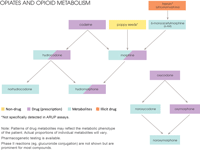
Opioid Metabolic Pathway
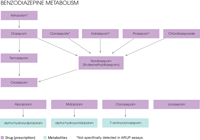
Benzodiazepine Metabolic Pathway
Source: https://arupconsult.com/content/newborn-drug-testing
0 Response to "How Do Babies Test Positive for Meth and Pot Through Cps"
Post a Comment